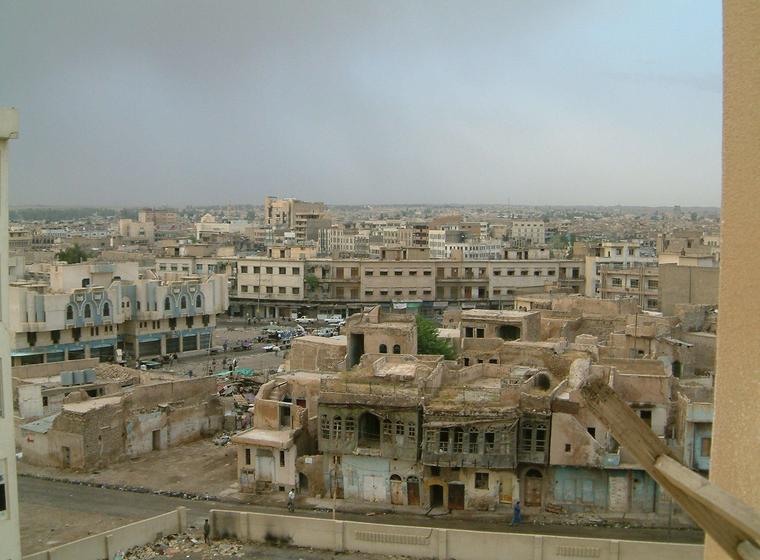
After performing my piece to the class and getting mostly positive feedback, I'm feeling a lot more confident with it than I was previously. I'm going to experiment without using the backing of the news report and see which one I feel fits best. I've also been doing more research into the issues the quotes I'm using deal with - eg: life in Mosul.
By doing this, I'm able to get a better idea of what they're talking about - I will not by any means be able to understand even a 0.1% of what they're going through, but I would like to try and gain a better understanding.
I'm going to work on really trying to push what I'm trying to show - the lengths these people have gone through to escape and what they're escaping. I'm trying to do it as respectfully as possible.
Sunday, 15 November 2015
Mosul
Mosul, a city located in Northern Iraq has been occupied by the Islamic State since the 10 June 2014.
Normally, the city would be home to 2.5 million - however, since the take over half a million have fled. Furthermore, it as once home to 60-70 thousand Chaldean and Christians, now there are none. Since the occupation, phone lines have been cut and all internet access destroyed.
"Life in Mosul is one of violent oppression where people suspected of activism against the occupiers, resistance activities, homosexuality, promiscuity or adultery are brutally and summarily tortured and murdered."
"IS takes a quarter of everyone's salary as a contribution towards paying for rebuilding the city. People can't say no because they would face harsh punishments. The group controls everything. Rent is paid to it and the hospitals are for its members' exclusive use."
Women have to be accompanied by a male at all times and are forced to cover themselves head to toe. Men are forbidden from shaving their beard and receive severe punishment if they do. Public executions have been known to be taking place since 2014, anyone who goes against ISIS' word is denounced and punished.
Normally, the city would be home to 2.5 million - however, since the take over half a million have fled. Furthermore, it as once home to 60-70 thousand Chaldean and Christians, now there are none. Since the occupation, phone lines have been cut and all internet access destroyed.
"IS takes a quarter of everyone's salary as a contribution towards paying for rebuilding the city. People can't say no because they would face harsh punishments. The group controls everything. Rent is paid to it and the hospitals are for its members' exclusive use."
Women have to be accompanied by a male at all times and are forced to cover themselves head to toe. Men are forbidden from shaving their beard and receive severe punishment if they do. Public executions have been known to be taking place since 2014, anyone who goes against ISIS' word is denounced and punished.
Monday, 9 November 2015
Syria became home...
To the Armenian refugees in 1915...
- In 1915 the Ottoman Empire carried out their "systematic extermination" of its minority Armenian subjects inside their historic homeland - modern day Turkey. The estimated total number of people killed is between 800,000 and 1.5 million. Many of the main 'killing fields' of the Armenian were in the Syrian dessert, Deir ez-Zor. After the arrival of the first groups of Armenian refugees (1915–1922) the population of Aleppo in 1922 counted 156,748 of which Muslims were 97,600 (62.26%), native Christians -mostly Catholics- 22,117 (14.11%), Jews 6,580 (4.20%), Europeans 2,652 (1.70%), Armenian refugees 20,007 (12.76%) and others 7,792 (4.97%)
- In 1948, the Palestinian exodus occurred when 700,000 Palestinian Arabs fled or were expelled during the 1948 Palestine War. The initial influx of Palestinian refugees was between 90,000-100,000. Through different laws the government paved the way for Palestinians to be integrated into their society whilst remaining this Palestinian identity.
- Post the 2003 invasion, the UNHCR estimates there are between 1 - 1.5 Million Iraqis in Syria in 2007. A large majority of the refugees have remained anonymous by not registering officially.
Though there are many instances of Syria acting as salvation for those seeking refugee, I thought I would highlight a few to show that now, when Syrian's need help, they're being treated as a problem. They're not the problem, the problem lies with what's causing them to flee - why is their homeland so unstable, who allowed to get this way? The problem lies with our world leaders bickering over what to do with millions of homeless refugees trying to seek safety in our privileged countries - if we were in trouble, they would expect help.
"Let it be written in the history books and let the generations remember, that when a Syrian needed help and refuge; borders were closed and the world looked away."
Taking Simon's advice with splitting up the piece, creating them separately and stitching them together afterwards, I summed each of the passages from the refugees up by one word or phrase. By summing my 4 passages I'm going to use for the verbatim aspect of my piece with one word, I'm able to give myself more detail to work off of. Though it arguably makes my job of creating the piece simpler, it also gives me a single word to build my objectives around which I feel will help me devise and create more effectively.
My passage of taken from HONY is a Iraqi refugee from Mosul in Salzburg, Austria. They talk about how they tried to avoid trouble but were reported by their neighbour "for shaving my beard" which caused them to be labelled as an atheist and lashed in the city centre. My obvious aim for this section of my piece to portray to the best of my ability someone possibly being trapped and punished for something so trivial - working off of the objective to be free and escape.
My second passage taken from HONY is from a refugee with unknown origins in Hegyeshalom, Austria. They explain how the war has impact his children and how it's changed their psychology - their normality is war. My aim with this second part is to discuss how the normality of war can impact people's psychologies in such a way that is irreparable - specifically with children.
My third passage taken from HONY is a refugee from Afghanistan - in Kos, Greece - who's family had to flee due to the Taliban. He explains how when the police found him and his family in Turkey, "they treated us like animals...like we weren't human." This third section I want to use animalistic movements to highlight the treatment of refugees and their experiences. We're discussing their lives as if they're a problem, as if they're sub human. They're not a problem. They're humans who are in need of grave help.
My final passage taken from is refugee from Baghdad, in Salzburg, Austria, who had to leave as they heard "the militas was planning to kill me" - They had leave without their family, "I'm all alone here". In the final part, I want to explore the loneliness felt by the refugees. Though thousands may have travelled with their family, there are still thousands who didn't. Thousands split from their family and their homeland due to conflict. Though there are millions travelling to and through Europe, they've all had different experiences - experiences no one else will ever have to go through like they did - that can be in no doubt, extremely lonely.
My passage of taken from HONY is a Iraqi refugee from Mosul in Salzburg, Austria. They talk about how they tried to avoid trouble but were reported by their neighbour "for shaving my beard" which caused them to be labelled as an atheist and lashed in the city centre. My obvious aim for this section of my piece to portray to the best of my ability someone possibly being trapped and punished for something so trivial - working off of the objective to be free and escape.
My second passage taken from HONY is from a refugee with unknown origins in Hegyeshalom, Austria. They explain how the war has impact his children and how it's changed their psychology - their normality is war. My aim with this second part is to discuss how the normality of war can impact people's psychologies in such a way that is irreparable - specifically with children.
My third passage taken from HONY is a refugee from Afghanistan - in Kos, Greece - who's family had to flee due to the Taliban. He explains how when the police found him and his family in Turkey, "they treated us like animals...like we weren't human." This third section I want to use animalistic movements to highlight the treatment of refugees and their experiences. We're discussing their lives as if they're a problem, as if they're sub human. They're not a problem. They're humans who are in need of grave help.
My final passage taken from is refugee from Baghdad, in Salzburg, Austria, who had to leave as they heard "the militas was planning to kill me" - They had leave without their family, "I'm all alone here". In the final part, I want to explore the loneliness felt by the refugees. Though thousands may have travelled with their family, there are still thousands who didn't. Thousands split from their family and their homeland due to conflict. Though there are millions travelling to and through Europe, they've all had different experiences - experiences no one else will ever have to go through like they did - that can be in no doubt, extremely lonely.
Subscribe to:
Comments (Atom)